Sunday, 16 August 2009

Film Review: A Perfect Getaway (2009)

Milla Jovovich as honeymooner Cydney in "A Perfect Getaway"

A couple on their honeymoon in Honolulu have been murdered. Enter Cliff (Steve Zahn) and Cydney (Milla Jovovich), a couple on their honeymoon in Honolulu. See where this is going? Although the news of the murders originally panics them, they decide, quite daftly, to continue with arranged plans and hit the foothills for a backpacking expedition to remember. But things get spooky when they encounter another couple who leave them cold. Soon, they’ve teamed with thrill seeking duo Nick (Timothy Olyphant) and Gina (Kiele Sanchez) in an attempt to keep potential killers at bay.

Once in a while a film will come along that leaves you with nothing. That film is A Perfect Getaway, a thriller built around a single concept that keeps you guessing for an hour before anything actually happens. It’s not that I couldn’t handle the tension – Deliverance, a somewhat similar movie, took just about an hour to establish the central problem and was brilliant in its build-up. You felt unnerved, and the atmosphere was something horrible, looming and uneasy. Here, it doesn’t go down as well. But I doubt I will ever be satisfied with a movie that bases itself entirely around a lone revelation. The characters are dull and cardboard, the story treats you like an idiot, and the whole thing is goofy and terribly unspectacular.

A lot of critics seemed relatively warm to this one. I can’t agree. On rare occasion will I leave a movie feeling exactly as I did going in. A Perfect Getaway left me blank. It didn’t spur a single emotion. The only redeeming factor? That Hawaii looked beautiful. I wish I’d spent 97 minutes there instead of with this. (**)

Sunday, 9 August 2009

Retro Review: Rashomon (1950)

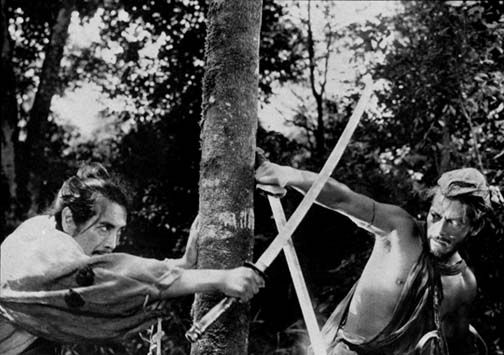
A battle takes place in one account of the same story in Akira Kurosawa's "Rashomon"

It is Rashomon, a film that opens so beautifully and remains that way for its entire running time, which reminds us of how affecting simplicity in the movies can be. It is a film by Akira Kurosawa, of course, and the one that brought attention to the Japanese director in the West when it came to the surface in 1951. He would go on to become one of Japan’s most respected filmmakers. If this is where the rest of world got their first glimpse of Kurosawa, it rings true that this is still a good place to start.

Rain pours in torrents in the opening moments of Rashomon, and the instant appeal comes from the way the whole thing looks. It is magnificently shot, in black and white, each frame as fine-looking as the best photographs. The camera has been placed with such care that it is noticeable from the off. Kurosawa understands the importance of how we see something – it is, in fact, the theme of the film.

We are introduced to three characters, a woodsman, a priest and a drifter. The woodsman and the priest are amidst a personal crisis – a woman has been raped, and her husband murdered. The woodsman found the body. The drifter wants to know why the pair are so miserable. It turns out that they don’t understand the circumstances of the incident – “I just don’t understand,” is the first line of the film – and are trying to put the pieces together. And so a mystery begins, and we are invited to listen to various accounts of the tale from the perspectives of those involved. But who, we ask, is telling the truth?

That we might never know is actually the point. As simple stories are recounted (in this case, to an off-camera court), Kurosawa cleverly reveals everything but really says nothing. We hear from the raped woman, a bandit, and even the ghost of the dead husband who speaks to the court through a medium, but all the time we are never really sure of the true events that took place. The genius lies within the fact that the camera is stripped of its usual role - playing the neutral eye. Instead, it becomes subject to lies and perspective, and shows us only what the characters want us to see.

Rashomon influenced many modern contemporaries, the most famous of which is Bryan Singer’s The Usual Suspects. It was also remade as western The Outrage, which starred Paul Newman. But where most imitators rely on complex details and unforeseen twists, it is here that a now tired formula thrives. The story here is deeply poignant, tactically simple, and manages to be both riveting and distressing. It is also a masterpiece of mood, to be remembered not only for its story but for its use of cinematography. There is something deep and unexplainable about its power, and its willingness to explore multiple angles in such a direct way. To call it Kurosawa’s masterwork may not be far off. What can be said for sure? That Rashomon might be the most important film about perspective ever made.
(*****)

Thursday, 6 August 2009

Retro Review: Hearts of Darkness: A Filmmaker's Apocalypse (1991)

Francis Ford Coppola on the set of "Apocalypse Now"

The documentary opens with a famous director addressing an audience. Without a hint of exaggeration, he says, “We were in the jungle, there were too many of us, we had access to too much money, too much equipment, and little by little… we went insane.” The lines are blurred: is he talking about the Vietnam War or the momentous film he made about it in 1979? The truth is, it doesn’t really matter. The fact is that they are a part of each other, and the beauty of the entire affair is that they are now wholly indistinguishable. “My film is Vietnam,” the director says, and he's right.

Francis Ford Coppola set out to create a film based on Joseph Conrad’s novel Heart of Darkness, a terrifying journey into the dark side of the human condition. The result was the masterpiece Apocalypse Now. But the reason the final product was so extraordinary was because, quite literally, Coppola lived the themes of the source novel during the time spent making his movie. The experience of making Apocalypse Now was what Apocalypse Now ended up as. It was as if it was all meant to be. Hearts of Darkness documents the making of the gargantuan project. It leaves nothing out.

Moments into the documentary, I was struck by a feeling of sickness. I had just heard Coppola confessing his feelings on the production to his wife, Eleanor. It is her footage and recordings that make up the bulk of the documentary. He mentions to her that he wants to shoot himself. That is how tired and incomprehensible the project had become. Then we see the sheer size of the sets and the extras, the constant building work, the unfinished script, and the unreliable military who Coppola cooperated with when making the movie. The feeling of sickness came from my imagining. Imagining the Hell that making this movie really was. Coppola would have been crazy not to have gone to such a dark place in his own head. That’s a human reaction, after all.

We’ve heard of the nightmare shoots concerning Spielberg and Jaws and Ridley Scott and Blade Runner, but neither of these come close to the chaos that Coppola encounters here. You’ll see it all. Marlon Brando turning up overweight, unfamiliar with the source material, threatening to leave the production with a $1 million advance. Martin Sheen replaces Harvey Keitel weeks into shooting. Later he suffers from a massive heart attack. Coppola argues with Dennis Hopper over the purpose of his character. The script is never really finished, leaving the director to force improvisation upon his actors. It’s a mess.

But Hearts of Darkness is a riveting piece of filmmaking in the sense that it is as engrossing and affecting as the very film it documents. We share interviews with the principal cast, writers, production assistants, and anybody and everybody that had a hand in the making. Some interviews are new, some from the set, but all are revealing and truthful. That is what separates it from almost every other making of documentary – it’s brutally honest. Most importantly, it’s essential, because understanding Hearts of Darkness is to understand Apocalypse Now itself. (*****)

Thursday, 16 July 2009

Film Review: Harry Potter and the Half-Blood Prince (2009)

Harry Potter and Ron Weasley discuss a forecoming game of Quidditch over breakfast with Hermione Granger

Adapting a well-loved novel to the big screen is always going to be a difficult process. No matter what anybody says, you can’t keep everybody happy – there’s just too much ground to cover. You have to please the fans, the newcomers, and the audience members who love the films but have never even picked up a copy of the book. In the past, the Harry Potter films have been adapted from J.K. Rowling’s source material fairly decently. Not badly enough so that hardcore fans were leaving the theatre in streams of tears, anyway. In terms of the novels that these crowd-summoning movies are based upon, Harry Potter and the Half-Blood Prince is the calm before the storm, the one where all the wheels are put into gear before the terrifying climax. Except it isn’t calm. It’s the storm before the storm. It’s a complicated, exciting web of discovery and urgency. If only the movie could have been something similar.

Harry Potter (Daniel Radcliffe) is due to begin his sixth year at Hogwarts School of Witchcraft and Wizardry. He spends his days riding trains and sitting in railway cafés, lost and confused in the aftermath of his encounter with Lord Voldemort. Soon enough, he is plucked out by his headmaster, the brilliant and enigmatic Albus Dumbledore (Michael Gambon), to carry a task before he returns. Dumbledore wants Harry to persuade Professor Slughorn (Jim Broadbent), who considers himself somewhat of a “collector” of brilliant and talent students, to return to Hogwarts. But Slughorn also holds a secret that is crucial in Harry’s quest to bring down Lord Voldemort. This is Harry’s mission for the sixth year: to discover it. By his side are best friends Ron (Rupert Grint) and Hermione (Emma Watson), who offer advice and support whilst trying to come to terms with whether or not they are more than fond of one another.

So begins a movie experience that is both entertaining and frustrating. Entertaining because, well, look, it’s Harry Potter, how can it be anything but entertaining? Yes, director David Yates offers us constantly appealing visuals and delivers a piece of filmmaking that is both confident and self-assured, but it’s frustrating because it doesn’t seem to utilize the opportunities that adapting this book give a filmmaker. It’s a film without energy, without perseverance, and worst of all, without love for its characters. Dark it may be, but Rowling’s novel found a balance between all the miserable and the magic. At the end of Half-Blood, I was asking, “Where’s the magic?”

It’s not that this is a completely bleak outing. There’s arguably more wit and humour in this one than in any of the previous five, but it’s displaced because there’s no connection between the characters. Yates seems to have succumbed to every aspect of the formula that Mike Newell brought to Harry Potter and the Goblet of Fire – the modern, iPod and Converse trainers approach. Each scene is just a scene, only there to bring us to the next one. You don’t feel anything between them. They just exist. It’s this aspect of the movie that will rile serious moviegoers and lovers of the book. The tone stays neutral all the way through. Rarely are you given the chance to feel nervous, or excited, or sad, or tense. You’ll plunder through, because you should, right? You just have to see how they handled that part of the book.

Characters pop up just to deliver lines, usually lifelessly, and without emotion. And the acting has taken a turn for the worst. Watching the student extras is awkward and embarrassing, especially when they have that single expositional line to utter. The scenes with Harry, Ron and Hermione as their established “trio” are lifeless and dull. They seem eager to be the gang they’re supposed to be, but somewhere along the line they’ve lost the chemistry, like they’ve given up. I blame some of this on some rigid screenwriting, but a looming unenthusiasm weaves throughout this entire tale.

Hagrid (Robbie Coltrane) appears now and again (to deliver some baiting story point) but he and Harry share not a single moment of companionship. This goes for Harry and Dumbledore too, who are supposed to be master and apprentice, like father and son, but actually share a rather bland and uninviting relationship. Gambon plays Dumbledore with a harder edge than Richard Harris did, and I was never comfortable or sure that that was the right decision. Jim Broadbent arguably steals the movie with Slughorn and is consistently joyous to watch, and though Snape (Alan Rickman) has been reduced, like so many, to a tool for delivering exposition, he remains captivating thanks to Rickman’s edgy performance.

The film’s constant need to inform us that Harry and Ginny (Bonnie Wright) and Ron and Hermione have romantic interest in each other goes from sweet to annoying very quickly. Their advancing relationships and sudden foray into adolescence is a big theme in Rowling’s novel, but there it was subtle and uncertain. Here it appears awkward, especially between Harry and Ginny, who insists on talking to Harry in loud whispers, bringing us scenes that force us to clench our teeth and look away. I understand that teenage romances are awkward and bumbling, but the execution here isn’t innocent and naïve: it’s uncomfortable.

It’s also interesting to note that this outing is extremely low on action sequences. The best action sequence in the book has been cut. The ones that are included (or have been created for unexplainable purposes) are boring and never announce to anything. When wands are drawn, the results are slow and uninspiring – sparks fly, people dive and duck about, and it’s over before anything even began. One thing to appreciate, however, is the special effects, which have only improved as the series has gone on. The production design is magnificent, and the detail on Hogwarts itself, the costumes, classrooms and Diagon Alley should be particularly appreciated.

But the movie seems so concerned with getting everything right, that it never slows down to enjoy itself. What we get, therefore, is a rather rigid adaptation. Writing that, I cannot dismiss the fact that I was never bored, and for the length of its running time, I found not one moment of the film to be dragging. It’s entertaining, audience-pleasing filmmaking. It’s just disappointing that so many things that could have easily gone right have gone wrong. Is it that much to ask that we feel some emotional attachment for these characters? Is it that much to ask that they feel some emotional attachment for each other?

After several movies in this vein, I must confess that I miss Chris Columbus. Not that his Harry Potter tales were anything phenomenal, but they certainly encompassed the magic I felt reading the books. And the characters were well drawn, and caring, and held a definite affinity for the material. Hagrid’s return from Azkaban at the end of Harry Potter and the Chamber of Secrets brought me to tears. The climax of Harry Potter and the Half-Blood Prince should have done something similar, but I felt rushed along by the narrative, and the moment was wasted. I’ll liken the experience to one of watching rainbow-coloured paint dry. You watch it because it’s alluring and enticing, but ultimately, it’s actually a rather empty way to spend two and a half hours. (***)

Sunday, 12 July 2009

Film Review: Public Enemies (2009)

A wounded John Dillinger (Johnny Depp) seeks solitude in Michael Mann's "Public Enemies"

John Dillinger is one of America’s great anti-heroes. Here is a man who robbed banks for a living. He even went as far as to say it was his “job” - if you think of Dillinger as a self-employed man, then he’s pretty much spot-on with that remark. A criminal he was, yet he became somewhat of an icon amongst America’s poorer folk, a sort of modern-day Robin Hood. Except he didn’t give any of the cash away. He kept it for himself. Michael Mann (of Heat fame) helms Public Enemies, which depicts Dillinger’s battle with the newly established FBI. Their intent is to stop him at any cost.

We open in a prison surrounded by walls so thick you could spend your lifetime chipping away at them and get nowhere close to anywhere inside. Here, Dillinger (Johnny Depp) and his partner John “Red” Hamilton (Jason Clarke) disguise themselves as guards. They get in. They rescue some of their own men. A few people are killed. Then we’re on the road with Dillinger as plans to take as many banks as possible, FBI agent Melvin Purvis (Christian Bale) hot on his tail.

Johnny Depp is chosen to play Dillinger. At first, this sounds like a first-rate decision. Depp, a skilled and extremely versatile actor, is capable of great performances both epic and subtle. Here, he fails. He plays Dillinger too quiet, too brooding, too distant. It’s no fun to watch. Of course, the film is part biopic, it is to base itself on facts, but from my understanding Dillinger was vibrant and vicious as much as he was icy and dry. The Dillinger we see is borderline boring. And the problem with Depp’s performance is the problem with the rest of the film itself – it’s all too cold.

There’s little drama in a movie that could have been rich with the stuff. We’re never given the opportunity to get inside Dillinger’s head. Save for a few broody shots of the man looking out of the window and thinking, there’s never a chance for us to connect with him. He’s an expensive canvas in a good suit with nothing painted on it. When it’s finally time to see Dillinger out, the experience is unemotional. We felt nothing for this man. Not hate, but no sympathy either. What did he stand for? What did he really want? These questions are never addressed.

The best performance comes from Stephen Graham, who plays Dillinger’s accomplice Baby Face Nelson – he gives his character some personally, some defiance that seems missing in everyone else. Christian Bale is rather underwhelming as Purvis. Not bad by any means, but just a tool here, an antagonist for Depp with no real face. Oscar-winner Marion Cotillard stars as Depp’s lover, Billie Frechette, lacing the performance with a nice air of tragedy, though it’s safe to say she won’t win her second Oscar for this.

What can be praised is the cinematography, but I’m not convinced by Mann’s decision to shoot in high definition. It’s an odd contrast to the 1930s setting, and proves to be only distracting. It wastes the spectacular production values in every shot, giving it the look of a television film. And your eyes might have a hard time focusing as the camera refuses to stay still. I’ll argue that this would have been better served on good old-fashioned film.

The main problem with Public Enemies is that is disappointing. It’s not a bad film, but it is not a great film either. The distance felt between the happenings on-screen and the audience makes sure of that. And the lack of dramatic energy is inexcusable – if Melvin Purvis can kill a man he never met in real life, then surely Dillinger can be gifted with an ounce of personality, true or otherwise. The real shame is this will probably always be viewed as the definitive Dillinger film. I will always view it as an opportunity wasted. Peter Travers wrote that Public Enemies is “movie dynamite.” Yes, alright. If the dynamite is never lit. (***)